

Ho la fortuna di conoscere personalmente Nicola Di Cesare grazie al progetto “artisti gaudenti” di Octagone, che ha visto protagonisti più di 50 artisti valtellinesi che hanno reso omaggio a Nicola e alla sua opera decorando piastrelle in ceramica ottagonali a tema “il mondo degli scacchi”.
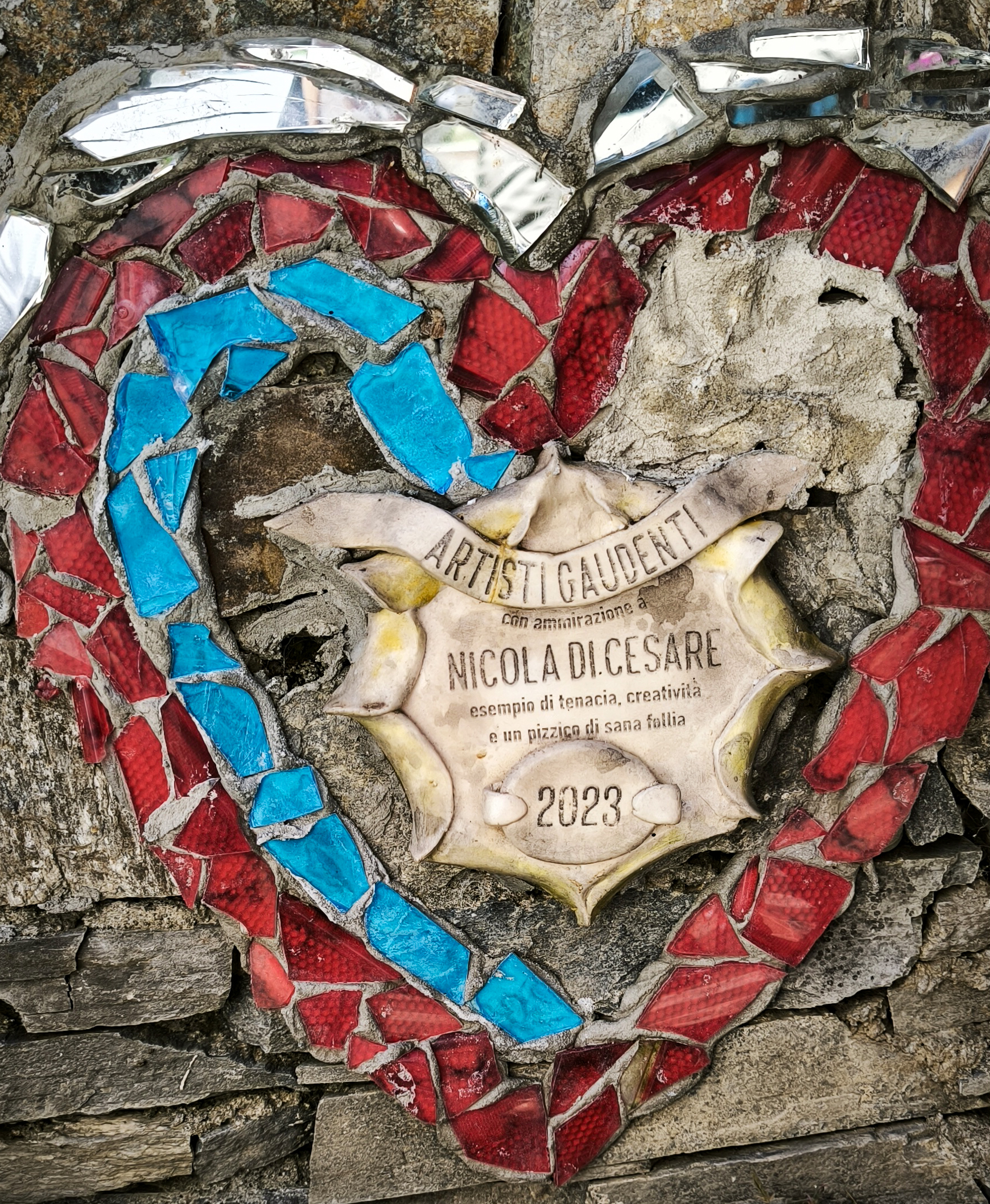
Una volta ultimate Nicola le ha incastonate lungo le pareti del suo giardina, offrendo così la possibilità di cimentarsi in una originale caccia al tesoro.
Ecco cos’è il “giardino roccioso di Nicola”.
A Grosio, nelle Alte Terre di Valtellina e Valchiavenna, esiste un luogo che sembra uscire da una fiaba: il Castello del Gaudì, o “Giardino Roccioso di Nicola Di Cesare”.
L’autore è Nicola Di Cesare, un simpatico abruzzese, che da oltre 42 anni sta scolpendo e decorando una parete rocciosa dietro casa sua nel borgo di Grosio, trasformandola in un’opera unica.
Il nome “Gaudì” è un soprannome datogli dalla gente per via della forte somiglianza stilistica evocate con le opere di Antoni Gaudí, benché Nicola dichiari che non si sia mai ispirato direttamente all’architetto catalano.
L’opera è un vero e proprio giardino verticale: 207 scalini che salgono per pendii rocciosi, con sentieri, arcate, grotte, muretti decorati e mosaici policromi che utilizzano materiali di recupero.
Molti tasselli dei mosaici provengono da materiali che sarebbero stati scartati: vetro, frammenti di ceramica, fanali di automobili, piccole pietre; ogni elemento recuperato è ripensato come parte dell’arte del luogo.
Piante, fiori, vasi decorativi, la natura che cresce attorno e dentro l’opera completano il paesaggio: l’artista non solo costruisce con la pietra, ma con il verde e la luce.
Il Castello del Gaudì non è un monumento storico antico, ma un’opera personale, spontanea, costruita “per passione”.
Parladone Nicola si sminuisce un po’, dice che ha iniziato solo per ricavare un pezzetto di terreno per farci un orto ma poi, evidentemente, si è fatto prendere la mano.
“Il giardino è il mio salva-matrimonio, io sto fuori a lavorare e non disturbo mia moglie che così vive felice”. Questo ama ripetere Nicola.
È edificato su via Rovaschiera, via che parte dal centro di Grosio, in un terreno roccioso che sovrasta la sua abitazione privata; il panorama dalla sua posizione regala scorci notevoli sulla valle.
L’ingresso al castello è gratuito (se vuoi puoi lasciare un’offerta) , ma è proprietà privata: per visitarlo è bene mettersi d’accordo con Nicola Di Cesare. Non c’è biglietto fisso, ma chi desidera può lasciare un’offerta libera.
Ci sono alcune cautele da prendere: le scalinate (207 gradini) richiedono scarpe comode; il terreno è accidentato, non adatto a chi ha difficoltà motorie.
Nel tempo, il giardino roccioso di Nicola è diventato meta turistica sorprendente: molti visitatori vengono non solo da Sondrio ma da fuori provincia, per vedere questa opera che coniuga arte, natura e recupero.
Quello che l’opera mostra bene è il grande lavoro individuale di valorizzazione del territorio: un uomo che cura la materia, recupera il recuperabile, trasforma un pendio roccioso in un patrimonio visivo che arricchisce la comunità.
Non solo estetica: è un segno di identità locale e di creatività che parte dal basso, senza grandi finanziamenti esterni, ma con costanza, sacrificio e ingegno.
Nicola non ha un profilo social ma è sorprendente vedere quanti post sono dedicati alla sua opera, attirando anche l’attenzione delle tv nazionali che diverse volte hanno intervistato Nicola e raccontato la sua storia e la sua generosità nel render fruibile a tutti la sua opera.
Se passi da Grosio, questo luogo è una sorpresa: perché mescola fiaba, paesaggio alpino, mosaici, colore e senso di casa.
Vale la pena includerlo nei percorsi che raccontano le alte terre contemporanee, non solo quella storica o naturale.
Grazie Nicola!
Luca Poletti
NICOLA DI CESARE’S ROCK GARDEN
STONE PETALS
I have had the good fortune to know nicola di cesare personally thanks to octagone’s “artisti gaudenti” project, which brought together more than fifty Valtellina artists to pay tribute to nicola and his remarkable work. each artist decorated an octagonal ceramic tile inspired by the theme of “the world of chess”.
Once they were completed, Nicola carefully set the tiles into the walls of his garden, creating an original treasure hunt for visitors to enjoy.
That is the essence of Nicola’s Rock Garden.
In Grosio, in the High Lands of Valtellina and Valchiavenna, there is a place that seems to have stepped straight out of a fairy tale: the Gaudì Castle, also known as Nicola Di Cesare’s Rock Garden.
Its creator is Nicola Di Cesare, a warm-hearted man originally from Abruzzo, who for more than forty-two years has been carving and decorating the rocky hillside behind his home in the village of Grosio, gradually transforming it into a truly unique work of art.
The nickname “Gaudì” was given to him by local people because of the striking resemblance between his creations and the works of Antoni Gaudí, although Nicola himself has always maintained that he was never directly inspired by the celebrated Catalan architect.
The site is, in every sense, a vertical garden: 207 steps winding their way up the rocky slope through pathways, arches, grottoes, decorated dry-stone walls and vibrant mosaics created from reclaimed materials.
Many of the mosaic pieces come from objects that would otherwise have been discarded: glass, fragments of ceramic, car headlamps and small stones. Every recovered element has been reimagined as part of the artwork itself.
Plants, flowers, ornamental pots and the vegetation that grows around—and within—the garden complete the landscape. Nicola builds not only with stone, but also with greenery and light.
The Gaudì Castle is not an ancient historical monument, but a deeply personal creation, built simply for the love of creating.
When talking about his work, Nicola is characteristically modest. He says it all began because he wanted to clear a small piece of land to grow a vegetable garden—but, as he happily admits, one thing simply led to another.
“The garden saved my marriage,” he likes to joke. “I stay outside working, and I don’t get in my wife’s way—so she’s happy.”
The garden stands on Via Rovaschiera, a street leading from the centre of Grosio. It occupies the rocky hillside above Nicola’s home and enjoys magnificent views across the valley.
Admission is free—although visitors are welcome to leave a donation—but the site remains private property, so it is advisable to arrange your visit with Nicola in advance. There is no fixed entrance fee; anyone wishing to support the project may simply leave a voluntary contribution.
A few practical considerations are worth bearing in mind: the climb involves 207 steps, comfortable footwear is essential, and the uneven terrain makes the site unsuitable for visitors with reduced mobility.
Over the years, Nicola’s Rock Garden has become one of the area’s most surprising visitor attractions. People travel not only from Sondrio but from far beyond the province to discover this extraordinary place, where art, nature and creative reuse come together in perfect harmony.
Perhaps its greatest achievement is the example it offers of how one individual can enrich an entire landscape. Nicola has patiently cared for the raw materials around him, giving discarded objects a new purpose and transforming a rocky hillside into a place of beauty that benefits the whole community.
It is more than an artistic creation. It is an expression of local identity and grassroots creativity—born not from major funding or grand institutions, but from perseverance, dedication and imagination.
Although Nicola has no social media presence, it is remarkable how many online posts celebrate his work. His garden has also attracted the attention of national television networks, which have featured his story on several occasions, highlighting both his extraordinary creativity and his generosity in opening his life’s work to everyone.
If your travels bring you to Grosio, this is a place full of surprises—a unique blend of fairy tale, Alpine landscape, colourful mosaics and an unmistakable sense of home.
It deserves a place among the experiences that tell the story of today’s High Lands, not only through their history and natural beauty, but also through the creativity and passion of the people who continue to shape them.
Thank you, Nicola!