
Penso che Bertacchi sia la figura più indicata per accompagnarci idealmente in questo nostro viaggio ludico alla scoperta delle alte terre di Valtellina e Valchiavenna.
Chissà come ci si vedrebbe in questo ruolo …
Ora un po’ di storia.
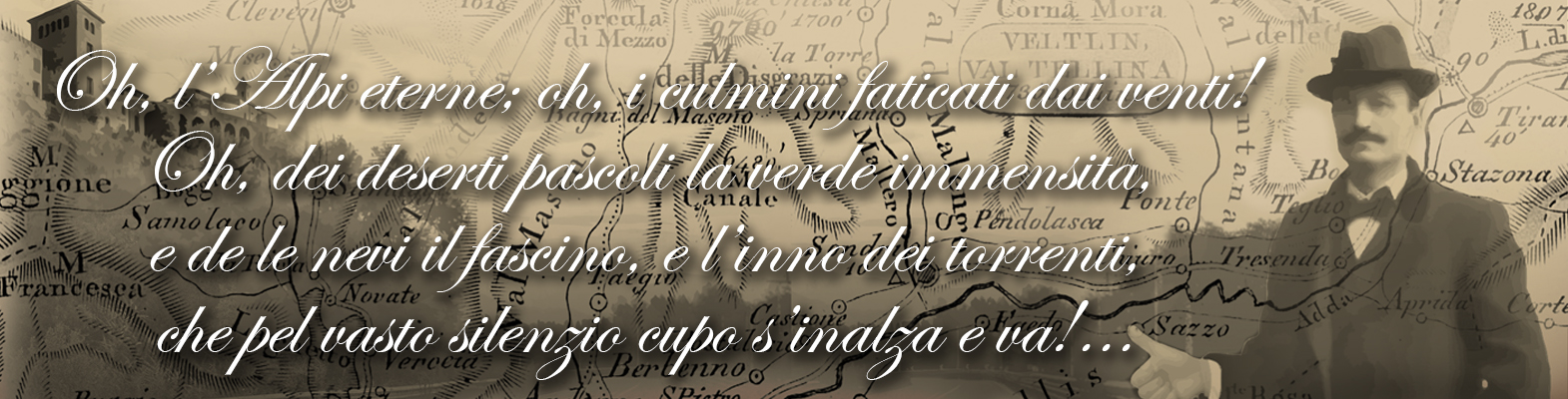
Giovanni Bertacchi nacque a Chiavenna il 9 febbraio 1869, in una valle che avrebbe custodito per sempre il suo affetto e la sua nostalgia per la propria terra. Fin da giovane, la bellezza delle montagne, dei crotti, delle piazze innevate e dei campanili (“i düu campanín”) divenne per lui materia poetica e ispirazione costante.
Dopo aver studiato e compiuto i suoi primi passi letterari, Bertacchi pubblicò nel 1895 il Canzoniere delle Alpi, raccolta che consacrò il suo legame con la montagna non come semplice sfondo, ma come presenza viva nei versi. In seguito alla prima produzione poetica, sviluppò anche una significativa attività di critico letterario, dedicandosi agli studi su autori come Dante, Leopardi, Manzoni, Alfieri e Mazzini.
La sua carriera accademica lo portò a insegnare Letteratura italiana all’Università di Padova dal 1916 al 1938, incarico che lasciò volontariamente in opposizione al regime fascista. Bertacchi fu quindi non solo poeta, ma anche docente e intellettuale impegnato nel dibattito culturale del suo tempo.
Nelle sue raccolte — tra cui Poemetti lirici, Le malie del passato, Liriche umane e A fior di silenzio — la voce poetica ripropone il suono del vento tra le valli, il riverbero della neve e l’intensità delle luci alpine, intrecciando grandi paesaggi con scene di vita quotidiana. In dialetto chiavennasco, negli ultimi anni di vita, scrisse versi impregnati di nostalgia per l’infanzia e per i luoghi d’origine.
Giovanni Bertacchi morì a Milano il 24 novembre 1942 e, secondo il suo desiderio, fu tumulato nel cimitero di Chiavenna in un sarcofago realizzato dallo scultore Enrico Pancera.
La memoria della sua opera è ancora viva oggi: Chiavenna celebra Bertacchi con eventi, premi e percorsi poetici legati alla sua figura. Il Premio Internazionale di Letteratura Giovanni Bertacchi, nato nel 2013, richiama poeti e appassionati da tutta Italia e dall’estero, valorizzando i luoghi che ispirarono il poeta e mantenendo vivo il dialogo tra letteratura e territorio.
I “luoghi bertacchiani” — dalla piazza del Municipio alla casa natale e al Rifugio Giovanni Bertacchi sul Lago d’Emet, che porta il suo nome — non sono semplici punti sulla mappa, ma simboli di un legame profondo tra il verso poetico e il paesaggio alpino che lo generò.
La poesia di Bertacchi resta un atto d’amore per la sua “piccola patria”: una voce che non solo celebrò i grandi panorami, ma anche i dettagli del vivere quotidiano tra le montagne, nei suoni del vento, nella pietra dei crotti e negli odori della legna che arde.
Luca Poletti
GIOVANNI BERTACCHI, THE BARD OF THE ALPS
I believe that Bertacchi is the ideal figure to accompany us, at least in spirit, on this enjoyable journey of discovery through the High Lands of Valtellina and Valchiavenna.
One wonders how he himself might have seen such a role…
Now, a little history.
Giovanni Bertacchi was born in Chiavenna on 9 February 1869, in a valley that would forever hold his affection and his longing for his homeland. From an early age, the beauty of the mountains, the crotti , the snow-covered squares and the bell towers (“i düu campanín“) became a source of poetic inspiration and a constant presence in his work.
After completing his studies and taking his first steps in the literary world, Bertacchi published the Canzoniere delle Alpi (Songs of the Alps) in 1895, a collection that established his profound bond with the mountains, not merely as a backdrop but as a living presence within his poetry. Following this early poetic success, he also developed a distinguished career as a literary critic, devoting his studies to authors such as Dante, Leopardi, Manzoni, Alfieri and Mazzini.
His academic career led him to teach Italian Literature at the University of Padua from 1916 to 1938, a position he voluntarily relinquished in opposition to the Fascist regime. Bertacchi was therefore not only a poet, but also a scholar and an intellectual actively engaged in the cultural debate of his time.
In his collections—including Poemetti lirici (Lyrical Poems), Le malie del passato (The Enchantments of the Past), Liriche umane (Human Lyrics) and A fior di silenzio (On the Edge of Silence)—his poetic voice echoes the sound of the wind sweeping through the valleys, the shimmering brilliance of the snow and the intensity of Alpine light, weaving together vast landscapes with scenes of everyday life. In the Chiavenna dialect, during the final years of his life, he composed verses steeped in nostalgia for his childhood and his native places.
Giovanni Bertacchi died in Milan on 24 November 1942 and, in accordance with his wishes, was laid to rest in the cemetery of Chiavenna in a sarcophagus created by the sculptor Enrico Pancera.
The legacy of his work remains very much alive today. Chiavenna continues to honour Bertacchi through events, literary prizes and poetry trails dedicated to his memory. Established in 2013, the Giovanni Bertacchi International Prize for Literature attracts poets and literature enthusiasts from across Italy and abroad, celebrating the places that inspired the poet while keeping alive the dialogue between literature and the local landscape.
The “Bertacchi places”—from the Town Hall Square to his birthplace and the Giovanni Bertacchi Mountain Hut on Lake Emet, which bears his name—are far more than simple points on a map. They stand as symbols of the profound bond between his poetry and the Alpine landscape that gave it life.
Bertacchi’s poetry remains a heartfelt declaration of love for his “little homeland”: a voice that celebrated not only sweeping mountain panoramas but also the quiet details of everyday life among the peaks, in the sound of the wind, in the stone walls of the crotti, and in the scent of burning wood.